Currently Empty: R0.00

Ultrafiltration for Municipal Water: Is It the Right Choice?
Ultrafiltration for municipal water is becoming an increasingly popular solution for homeowners, businesses, and institutions that want to improve the quality of their drinking water. Although municipal water undergoes treatment before it reaches your tap, it can still collect suspended particles, rust, sediment, and other impurities as it travels through ageing pipelines and storage reservoirs.
Fortunately, ultrafiltration provides an effective second barrier that removes microscopic contaminants without stripping away naturally occurring minerals. As a result, it delivers cleaner, clearer water while preserving its natural composition.
Unlike some advanced purification technologies, ultrafiltration relies on physical filtration rather than chemicals. Therefore, it offers an environmentally friendly and cost-effective way to improve municipal water quality for everyday use.
Why Municipal Water May Need Additional Filtration
Municipal water treatment plants work hard to provide safe drinking water. They remove harmful contaminants and disinfect the water before distributing it through extensive pipe networks.
However, water quality can change before it reaches your property.
Several factors may affect municipal water during distribution, including:
- Ageing water pipelines
- Pipe corrosion
- Rust particles
- Fine sediment
- Sand
- Biofilm inside pipes
- Temporary maintenance work
- Water main repairs
Consequently, the water arriving at your home or business may contain suspended particles that were not present when it left the treatment plant.
For this reason, many property owners install ultrafiltration for municipal water as an additional level of protection.
How Ultrafiltration for Municipal Water Works
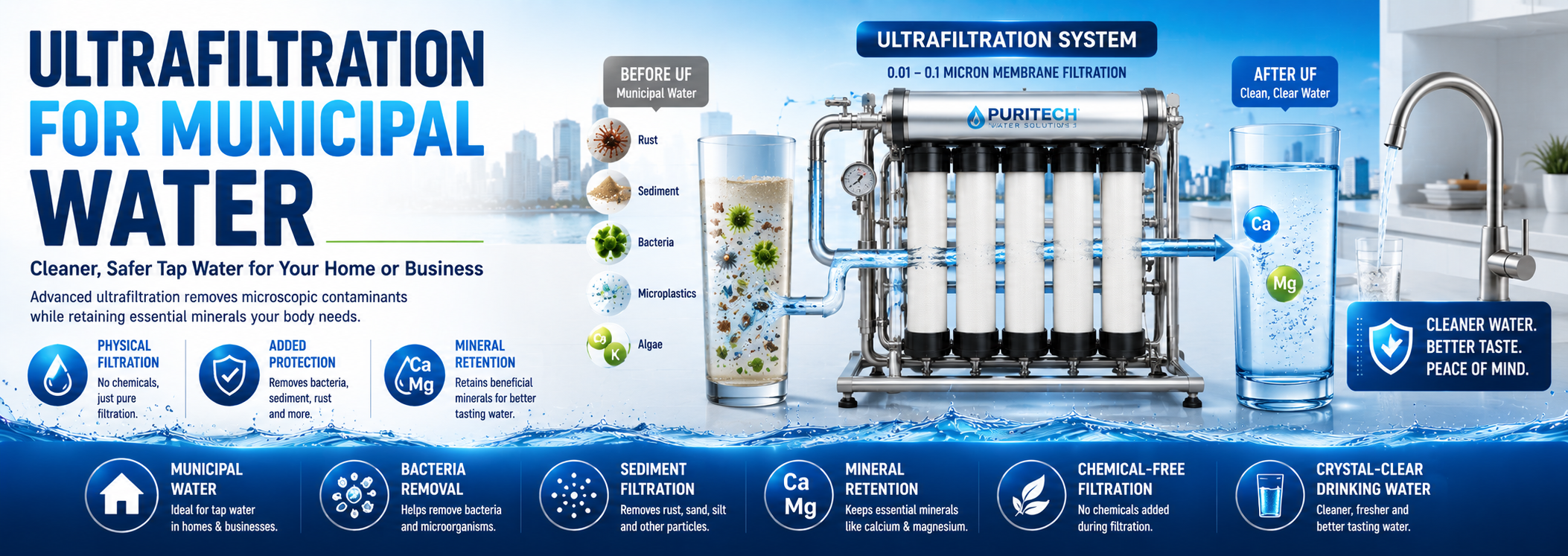
An ultrafiltration system uses a specialised hollow-fibre membrane containing microscopic pores, typically between 0.01 and 0.1 microns.
As municipal water passes through the membrane under pressure, suspended contaminants remain on the outside of the fibres while purified water passes through to the outlet.
Because the membrane performs physical separation rather than chemical treatment, the filtration process is both efficient and reliable.
Most importantly, dissolved minerals such as calcium and magnesium continue flowing through the membrane because they are much smaller than its pores.
Therefore, ultrafiltration improves water quality without removing beneficial minerals.
What Ultrafiltration for Municipal Water Removes
One of the biggest advantages of ultrafiltration for municipal water is its ability to remove a wide range of physical contaminants.
These include:
Suspended Solids
Ultrafiltration effectively removes:
- Sand
- Silt
- Fine sediment
- Rust particles
- Pipe scale
- Mud
As a result, drinking water becomes noticeably clearer.
Bacteria
Many bacteria are significantly larger than the membrane pores.
Consequently, ultrafiltration provides excellent protection against bacterial contamination that may occur within ageing distribution systems.
Algae and Organic Matter
Microscopic algae and organic particles can affect water clarity and appearance.
Fortunately, ultrafiltration retains these contaminants before they reach your tap.
Microplastics
Growing concerns about microplastics have increased interest in advanced water filtration.
Ultrafiltration removes many microscopic plastic particles that may be present in municipal water supplies.
Turbidity
Suspended particles usually cause cloudy water.
Ultrafiltration significantly reduces turbidity, producing cleaner and more attractive drinking water.
Benefits of Ultrafiltration for Municipal Water
Installing ultrafiltration for municipal water offers several important benefits.
Cleaner Drinking Water
By removing suspended contaminants, ultrafiltration improves both the appearance and quality of drinking water.
Retains Beneficial Minerals
Unlike reverse osmosis, ultrafiltration allows naturally occurring minerals such as calcium and magnesium to remain in the water.
Many people prefer this because the water retains its natural taste.
Chemical-Free Filtration
Ultrafiltration relies on membrane technology instead of chemical additives.
Therefore, the filtration process remains environmentally friendly and efficient.
Protects Household Appliances
Cleaner water helps reduce sediment entering:
- Coffee machines
- Ice makers
- Water dispensers
- Beverage equipment
- Instant boiling water systems
Consequently, appliances often require less maintenance and may last longer.
Lower Operating Costs
Because ultrafiltration uses relatively low operating pressure and does not require expensive consumables, operating costs remain affordable for most households and businesses.
Is Ultrafiltration for Municipal Water Enough?
In many situations, ultrafiltration for municipal water provides an excellent solution for improving drinking water quality. However, every municipal water supply is different. Therefore, choosing the right treatment system should always begin with a recent water analysis.
If the water mainly contains suspended particles, bacteria or turbidity, ultrafiltration is often the ideal choice. On the other hand, if the water contains high levels of dissolved salts, heavy metals or other dissolved contaminants, additional treatment stages may be required.
For this reason, many water treatment professionals recommend analysing the incoming water before selecting a purification system.
When Should Additional Water Treatment Be Considered?
Although ultrafiltration for municipal water removes many physical contaminants, it does not remove every type of impurity.
Additional treatment may be recommended if the water analysis identifies:
- High Total Dissolved Solids (TDS)
- Elevated nitrate levels
- Dissolved heavy metals
- High salinity
- Excessive chlorine taste or odour
- Specific chemical contaminants
Fortunately, ultrafiltration integrates easily with other treatment technologies when required.
Combining Ultrafiltration with Other Water Treatment Systems
Many water purification systems combine ultrafiltration with additional filtration stages to address a broader range of contaminants.
Activated Carbon Filtration
Activated carbon is commonly installed before or after the ultrafiltration membrane.
It helps reduce:
- Chlorine
- Unpleasant tastes
- Unpleasant odours
- Certain organic compounds
As a result, the water often tastes and smells fresher.
Reverse Osmosis
Where dissolved contaminants are present, reverse osmosis may be added after ultrafiltration.
This combination removes:
- Dissolved salts
- Heavy metals
- High TDS
- Many dissolved chemicals
Furthermore, ultrafiltration protects the reverse osmosis membrane by removing suspended particles before they reach it.
Ultraviolet (UV) Disinfection
Some applications require an additional level of microbiological protection.
In these cases, ultraviolet disinfection provides an effective final treatment stage without adding chemicals.
Where Ultrafiltration for Municipal Water Works Best
Because of its versatility, ultrafiltration for municipal water is suitable for a wide variety of applications.
Residential Homes
Families enjoy cleaner drinking water while retaining beneficial minerals.
Office Buildings
Businesses provide employees and visitors with consistently high-quality drinking water.
Restaurants and Cafés
Food service businesses benefit from cleaner water for beverages, cooking and food preparation.
Schools and Universities
Educational institutions can improve drinking water quality for students and staff.
Healthcare Facilities
Hospitals, clinics and medical centres often use ultrafiltration as part of comprehensive water treatment systems.
Hotels and Hospitality
Hotels can improve guest satisfaction by providing cleaner, better-tasting water throughout the property.
Maintaining an Ultrafiltration System
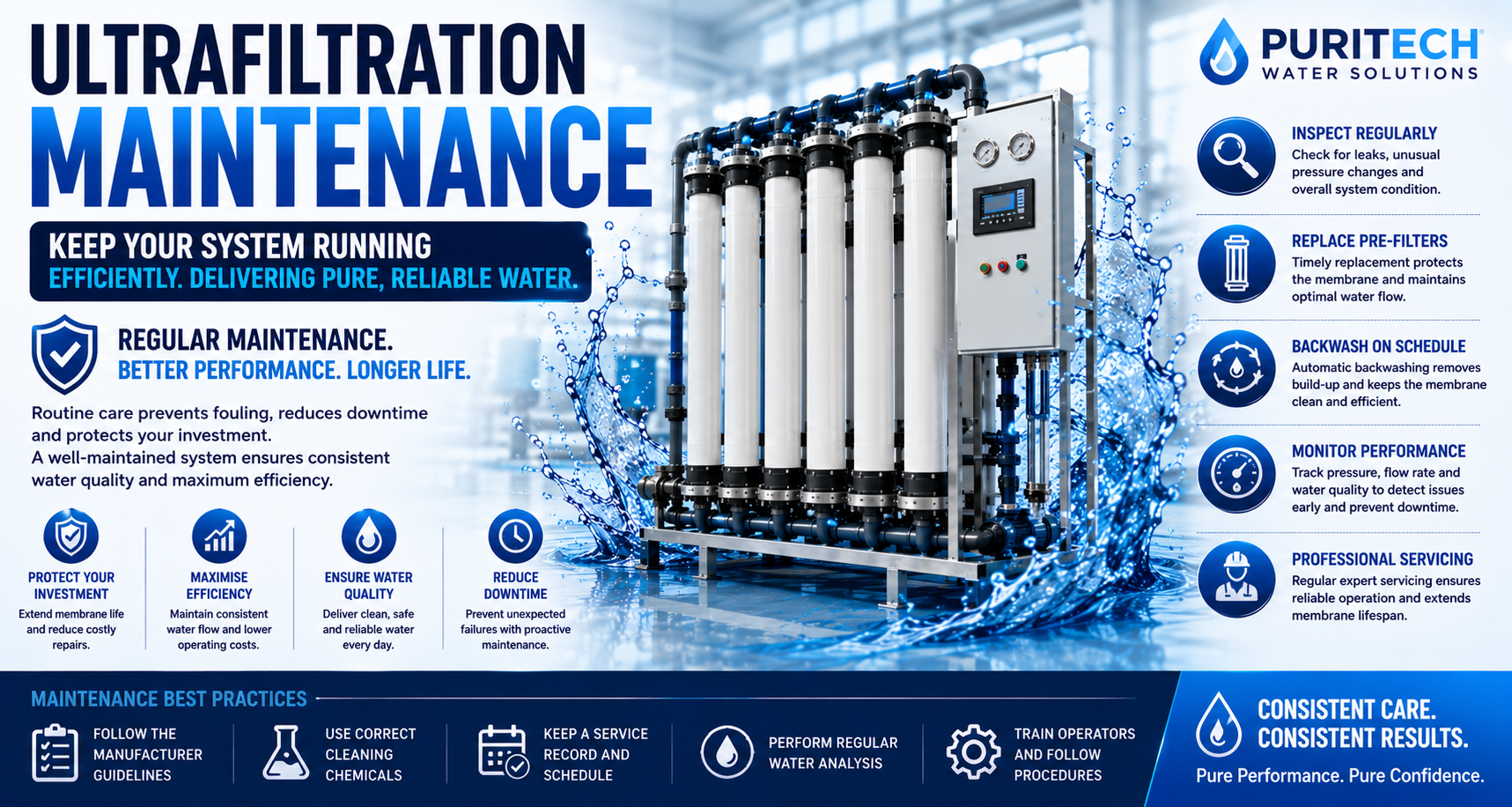
Routine maintenance helps ensure that ultrafiltration for municipal water continues operating efficiently.
Fortunately, maintenance requirements are generally straightforward.
Typical maintenance includes the following:
- Replacing pre-filter cartridges
- Inspecting operating pressure
- Flushing or backwashing the membrane where applicable
- Checking flow rates
- Inspecting valves and pipe connections
- Scheduling routine servicing
Regular maintenance not only protects the membrane but also helps maintain consistent water quality.
Choosing the Right Ultrafiltration System
Selecting the correct ultrafiltration system depends on several important factors.
Before making a decision, consider:
- Daily water consumption
- Number of users
- Incoming water quality
- Available water pressure
- Installation space
- Future water demand
In addition, choosing a professionally designed system ensures reliable performance and easier maintenance over the long term.
Why a Professional Water Analysis Is Important
No two municipal water supplies are the same.
Although municipalities work hard to provide safe drinking water, water quality can vary depending on the location, pipe network, and local infrastructure.
A professional water analysis measures important parameters such as the following:
- pH
- Total Dissolved Solids (TDS)
- Conductivity
- Hardness
- Iron
- Manganese
- Turbidity
- Microbiological contamination
These results help determine whether ultrafiltration for municipal water is sufficient on its own or whether additional treatment stages should be included.
Frequently Asked Questions
Is ultrafiltration for municipal water suitable for every home?
In most cases, yes. Ultrafiltration for municipal water is suitable for homes supplied by municipal water, especially where the goal is to remove suspended contaminants while retaining naturally occurring minerals. However, a recent water analysis is always recommended before selecting any water treatment system.
Does ultrafiltration for municipal water remove chlorine?
No. Ultrafiltration membranes do not remove dissolved chlorine because chlorine molecules are much smaller than the membrane pores.
If chlorine reduction is required, an activated carbon filter should be installed before or after the ultrafiltration system. Together, these technologies provide excellent overall water treatment.
Does ultrafiltration for municipal water remove bacteria?
Yes. One of the biggest advantages of ultrafiltration for municipal water is its ability to remove most bacteria, suspended solids, algae and many other microscopic contaminants through physical filtration.
Does ultrafiltration for municipal water remove minerals?
No. Ultrafiltration retains naturally dissolved minerals such as calcium and magnesium because these minerals are much smaller than the membrane pores.
Many homeowners prefer this because the water maintains its natural mineral content.
How often should an ultrafiltration system be serviced?
Service intervals depend on water quality, daily usage and the specific equipment installed.
Generally, routine maintenance includes:
- Replacing pre-filter cartridges
- Inspecting the membrane
- Flushing or backwashing where applicable
- Checking operating pressure
- Inspecting valves and fittings
Following the manufacturer’s maintenance schedule helps maximise system performance and membrane lifespan.
Can ultrafiltration for municipal water improve taste?
Yes. By removing suspended particles and working alongside activated carbon filtration where appropriate, ultrafiltration for municipal water can significantly improve the taste, clarity and overall quality of drinking water.
Conclusion
Ultrafiltration for municipal water is an effective and reliable way to improve the quality of treated tap water without removing beneficial minerals. By filtering out suspended solids, bacteria, algae, microplastics and other microscopic contaminants, ultrafiltration delivers cleaner, clearer water for homes, businesses and commercial facilities.
Although municipal water is generally safe, additional filtration provides an extra level of confidence while helping protect appliances and improving the overall drinking experience. Furthermore, because ultrafiltration uses physical membrane technology rather than chemicals, it offers an environmentally friendly and cost-effective solution for long-term water treatment.
For the best results, always base your system selection on a recent professional water analysis. This ensures your treatment solution matches the actual quality of your incoming water and provides reliable performance for years to come.